What's Here

As the title indicates, I post stuff here only at irregular intervals.

The December 2019 entries deal with the restoration of my harpsichord.  The entries from the summer of 2019 are about the replacement of the slate roof on my house.  For the latter, see the Archives at the right.

Posted By David

My harpsichord is now 30 years old (!) and, like many things of a certain age, was in need of a tune-up.  I could have done some of the updates myself but I wanted to put the instrument in really good shape, so I decided it was time to give the job to a professional.  I contracted with historical keyboard specialist Anne Acker (see her website here).  She did a wonderful job and I want to thank her for all the effort she put into my harpsichord.  She also discovered two issues that I was not aware of and that would have caused problems down the road if not addressed.  As a result of her work, the instrument should be in good shape for as long as I use it and then be ready to move on to someone else.

Note: you can right-click on any of the pictures below and choose View Image to get a larger/more detailed photo; use your browser's Back button to return to the main blog.

There were a few things I never got to do before I had to vacate the basement (a friend’s, not my own) where I built the instrument.  Chief among these was putting on the gold bands that are traditional decoration for a French-style harpsichord, along with gilding the case moldings.  (Yes, we use real gold leaf.)  There were a few other cosmetic issues that needed taking care of also.

Instrument as delivered after restoration.
 

The photo above shows the instrument after it came back home on December 6, with the gold bands.  (Please ignore the mess in the parlor — woodwork refinishing in progress.)

Below is a view of the keywell, with newly gilded moldings visible.  You can also see the new music desk.

Keywell with new music desk.


The original music desk is a folding design that fits inside the closed instrument; a clever use of space, but it is too small and insecure to hold a large book and the top section tends to slip down without warning:

The original music desk.


Plectra (the little horizontal things that pluck the strings) harden with age, so it was time for re-quilling.  (We use the term ‘quilling’ even if the plectra are made of plastic rather than bird quill as was done in the Baroque era — although some people today do use actual quills.)  Strings don’t last forever either; I could have put off re-stringing for a while, but now we have access to better wire than was available 30 years ago, so I decided to have it re-strung along with the revoicing.   Here is some of the historical music wire that Anne installed (‘Nuremberg’ refers to a system of wire measurement used in the 18th century):

Spool of historical music wire.
 

I decided to replace the jacks (the vertical pieces that rise up when a key is pressed and cause the plectra to pluck the strings).  The jacks that came with the kit were made of plastic; these eventually deform (although mine had not yet done so), and replacements in the original style will probably not be available in the future. This was not part of my original plan, and it added considerable complexity and cost to the project, but I think it was worth doing.  Here is one of the original plastic jacks next to one of the new pearwood ones.  The new jacks, made by a gentleman on the west coast who specializes in this work, are works of art and made to very exacting specifications.

Plastic and wooden jacks side by side.
 

This harpsichord has three sets of strings and four sets of jacks, as you can see in the next photo.  The fourth (rightmost) set of jacks plucks the same set of strings as the third set, but has plectra of soft leather instead of plastic.


Treble end of gap, showing registers and jacks.
 

The jacks live in a gap between the soundboard and the pinblock.  To keep the gap from closing up under the tension of the strings, there are three spacers.  The original spacers were made of wood and had begun to deform under pressure; Anne replaced them with iron ones.

New spacers visible in the gap.
 

Here is a closeup of the plectra, two in plastic and one in leather:

Closeup of plectra on three jacks.
 

The instrument now sounds and feels wonderful to play! The historical wire produces a tone with more fundamental than modern wire.  (The sound of any harpsichord has more overtones in comparison with that of a piano, and poor-quality wire or poor voicing can result in an overly bright effect.  So more fundamental is good.)  The result is definitely worth the wait — almost a year until Anne had an opening in her schedule — as well as the cost!  I don't have equipment to make a decent recording of it, but its sound has a definite family resemblance to a wonderful harpsichord made in Paris by Henri Hemsch in 1756.  Here is a link to Mireille Lagacé playing the harpsichord suites of Joseph Bodin de Boismortier on the Hemsch; listen on some decent speakers or headphones, not earbuds.  I suggest the second suite, which begins at 25:07.


Posted By David

It took three days for the mill to make the missing piece of ridge roll.  The crew arrived in the early afternoon and worked into the early evening installing this piece and doing a final cleanup.  It took 17 days of work, interspersed with five days lost to rain, and a couple of Sundays when they didn't work -- 25 days altogether.  Aside from the weather, the job went smoothly and I am pleased with the result.  It is nice to have my driveway back at last!

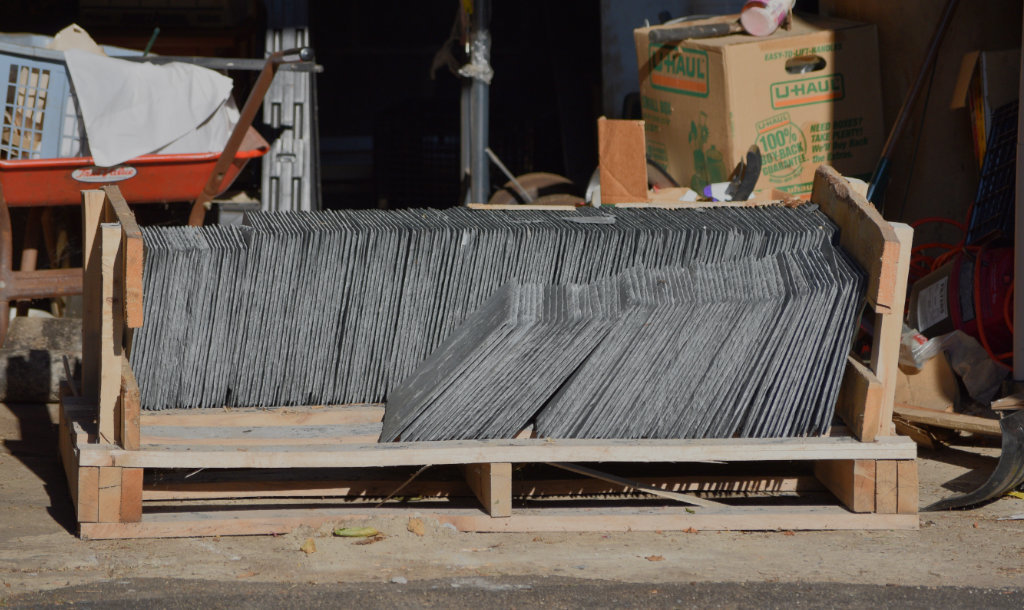
Here's the leftover slate in my garage.  It's not likely that any repairs will be needed while I own the house, but I will leave it for future owners.

Leftover slate in garage.
 

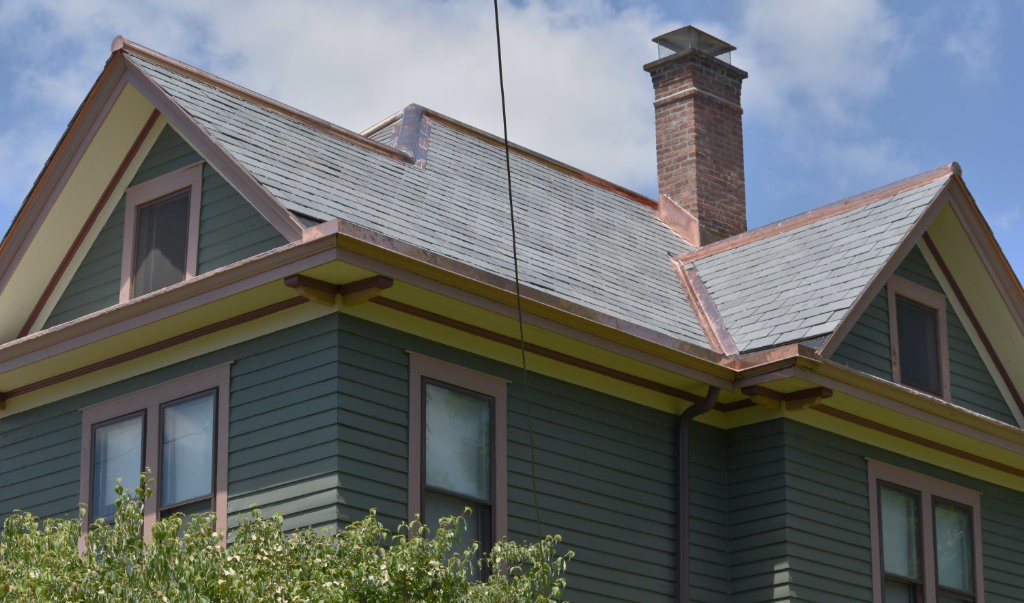
Here are some shots of the final result (zoom in for a closer look).  The east side:

East side all done.
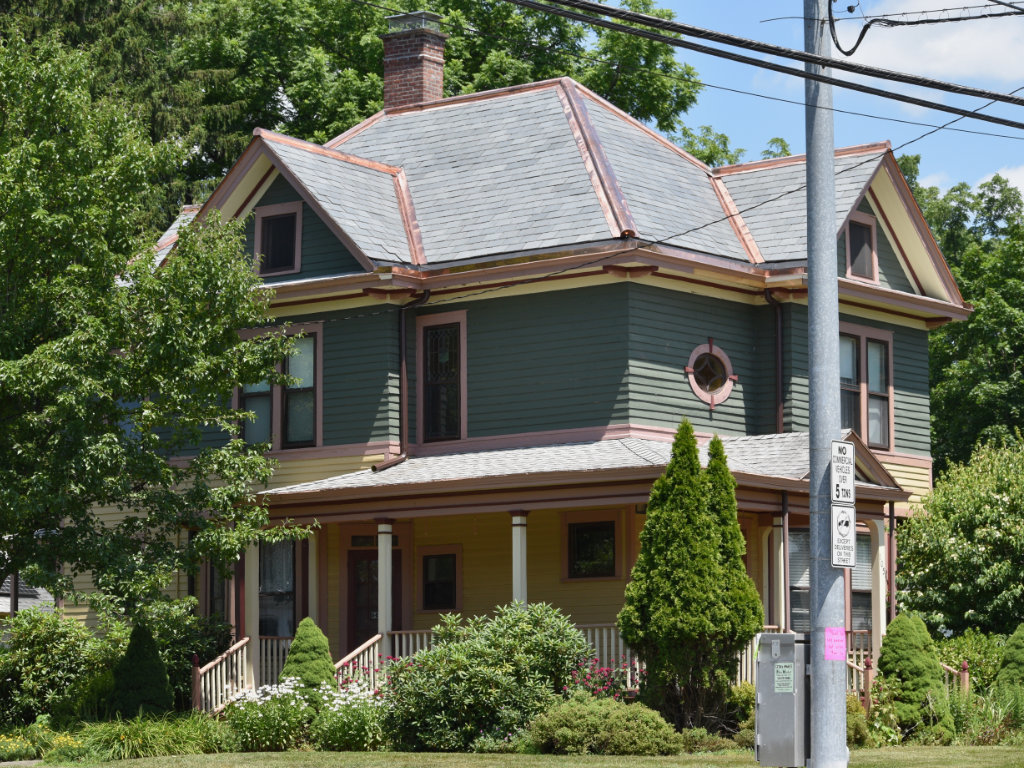
The southwest from across the street:

Southwest corner from a distance.
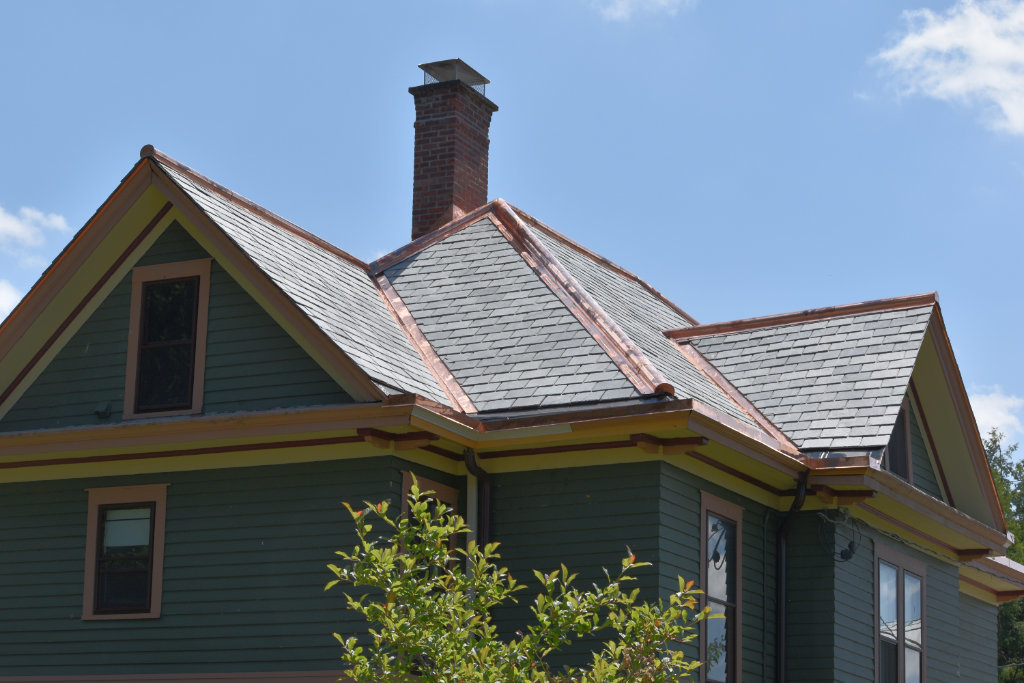
The northwest corner:

Northwest corner.


Posted By David

Today's task was to finish the copper edging on the gutters and gable ends.  They had already built up the edge of the gutters by adding a 2 x 4, as shown in the post for Days 2 and 3.  One day a sudden rainstorm arrived while they were working, and the foreman noticed that water was spilling over the gutter edge in a couple of spots despite the addtional height.  He and my contractor came up with the idea of shaping the copper edging to add another inch or more of height, which will -- I very much hope -- finally keep the rain inside the gutter.  I want to commend them for taking this extra step, which some guys wouldn't have bothered to do since we had already agreed on the 2 x 4 solution.

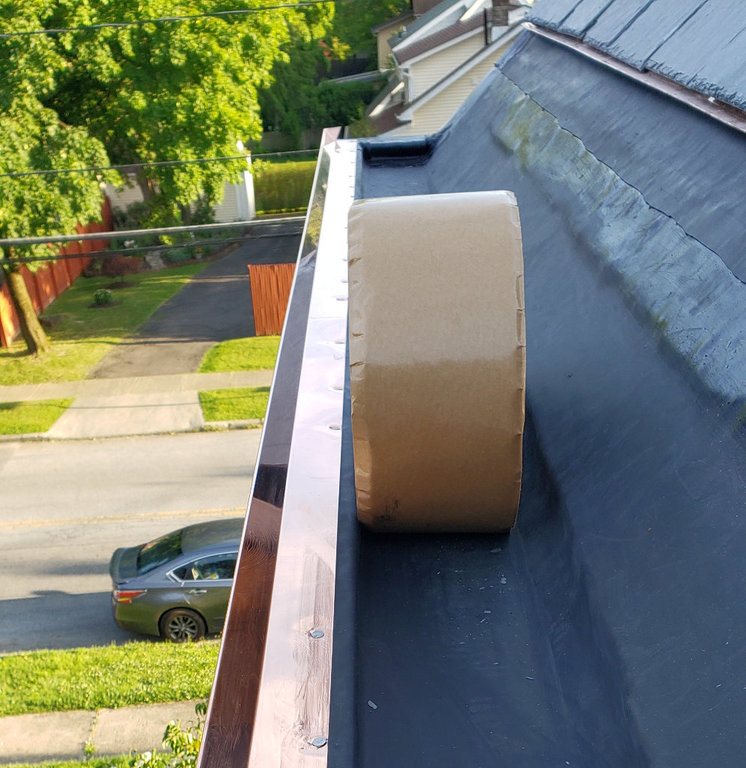
Here you can see the complete gutter repairs, with the black EPDM membrane, the 2 x 4, and the raised outer edging.  (Sorry about the roll of tape!)

Inside of gutter.
 

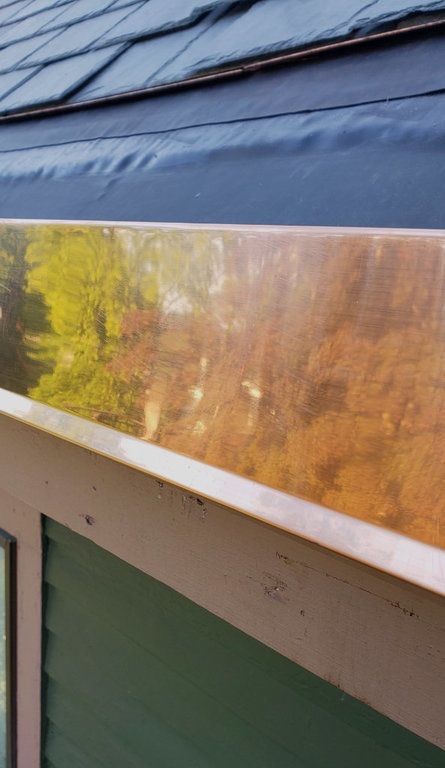
The bottom of the copper edging is angled out and extends a little below the top of the crown molding.  This should prevent water from getting behind the molding as happened in several spots with the original gutters.

Copper edging on outside of gutter.


Posted By David

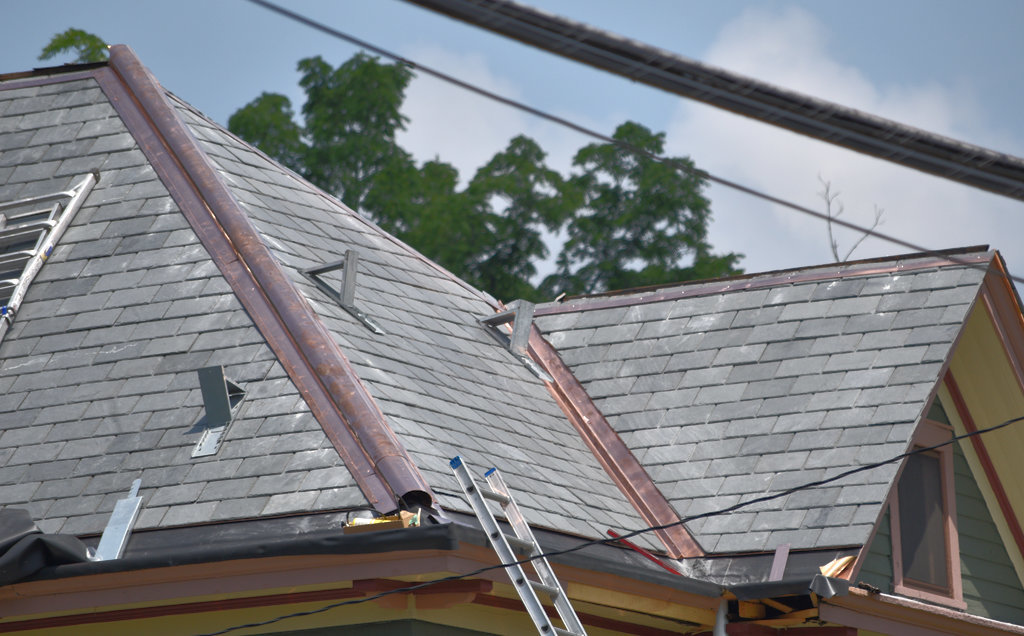
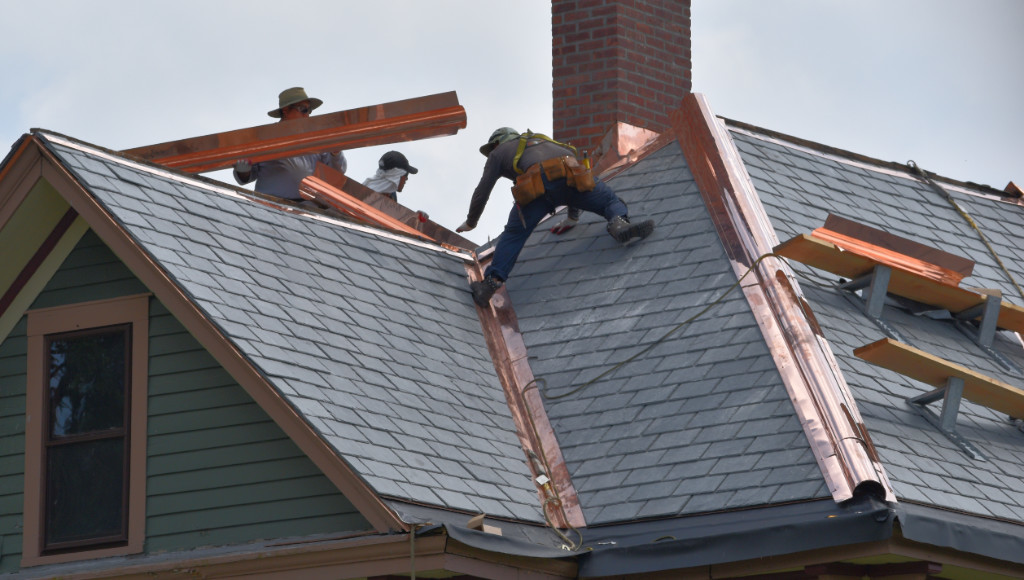
Today they finished installing the ridge cap, including all the soldering, which is a milestone.  Well, almost . . . .  My contractor found that they were short one piece of ridge roll.  He noticed the problem on Friday; today is Saturday and the mill won't make the missing piece until Monday at the earliest.  But now the roof looks finished from the south and west, the sides that are most visible from the street.  They also did a bunch of cleanup now that they had room in the dumpster, so the area around my driveway looks better.  The copper edging on the gutters remains to be done.

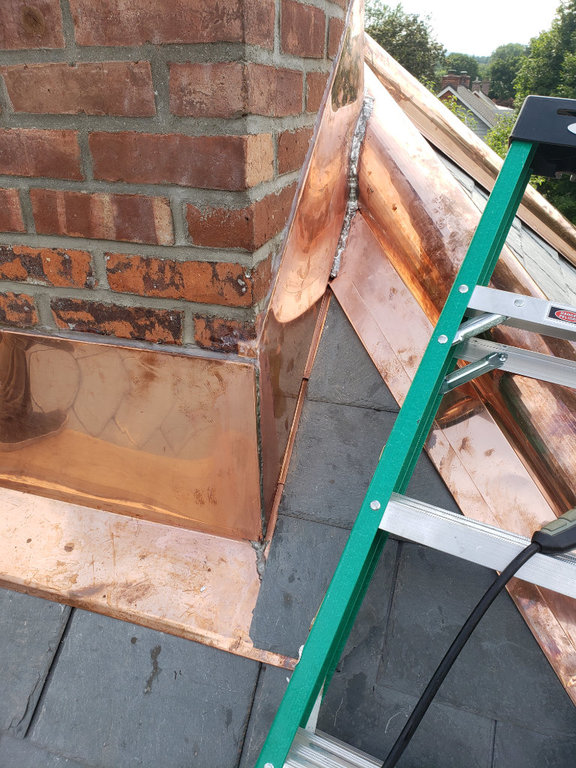
My contractor finally got me the photos they took on the roof, so I added some here.  This is a complicated roof.  The chimney emerges just to the east of the main ridgeline.  In this photo you can see the intersection of the ridge rolls and the chimney flashing.

Chimney flashing.
 

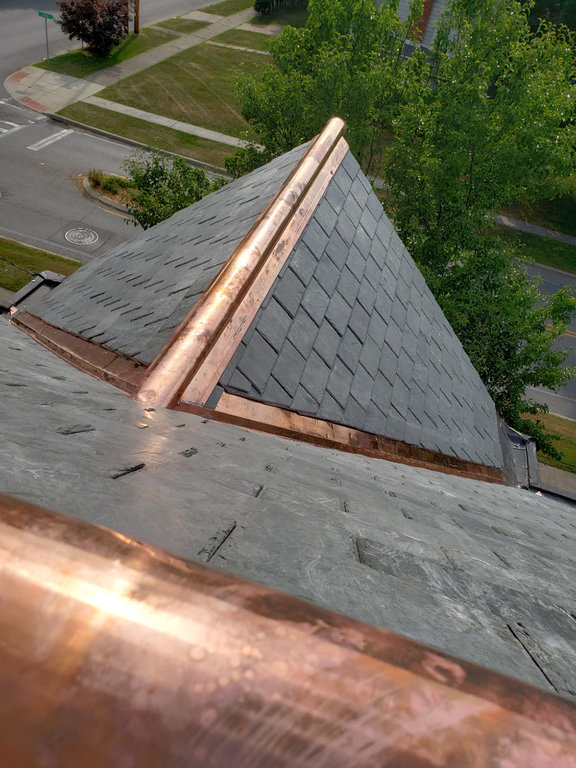
Looking down on the west reverse gable--nice view of the slate as well as the copper:

West gable from above.

The northwest corner.  Notice the the Yankee gutter at the center right.  At the bottom you can see the cleat into which the ridge roll is fitted.  Using cleats, rather than fastening the ridge caps directly to the roof, is the preferable method.


Ridge roll closeup.


Posted By David

They obtained some appropriate fasteners on Wednesday afternoon, so they could start installing the ridge roll today.  (The problem was that in a few spots near the hips, the screws were not biting firmly enough.)  The crew did some work (cleats? more gutters?) early and then before noon began with the ridge roll.  I went out about 2:00 to move my car because they needed to take the full dumpster and bring an empty one.  They had already installed additional cleats plus the roll on the SW corner and were working on the NW corner ridge; see pictures (zoom in for better view).  By the end of the day almost all the ridge roll was done.

The first ridge roll went on the SE.  Note also the cleats at the top of the gable that will hold the ridge roll.

First ridge roll on SW.
 

Here they are on the northwest corner.

Ridge roll installation NW corner.
In the two photos above, notice that the slate does not come all the way down to the gutter; the black EPDM membrane is visible even from the ground.  I recalled that in the old roof the slate came down one more course.  I asked my contractor about this.  He said that's how they did it back in the day, but that now it's considered better to keep the slate a little further up to avoid any problems when snow or ice sits in the gutter.  (The EPDM goes up 3' or so under the slate.)  I prefer the original look, but avoiding water problems is certainly a Good Thing.  My contractor also said that it would not be difficult to line the gutters with copper if I really don't like seeing the EPDM.  (Let's not get carried away here . . . )


Google

Archives
 
Visitors

You have 19975 hits.